

Wholesale Fitness Apparel: Best Suppliers 2026
Best for bodybuilding-focused retailers: Physique Bodyware. Best for blank workout apparel: SanMar. Best for your own clothing label: Apliiq. Best for discovering independent brands: Faire. This 2026 wholesale fitness apparel guide separates those buying routes so you can choose a supplier that matches your customers, not just fill a clothing rack.
- Physique Bodyware is the best wholesale fitness apparel fit here for retailers serving bodybuilders who buy stringer tanks.
- SanMar fits retailers sourcing blank workout apparel; Apliiq fits retailers developing their own gym clothing label.
- Faire is a wholesale marketplace, not a single manufacturer; evaluate each brand separately.
- Compare garment fit, written order terms, and reorder requirements before committing to a wholesale supplier.
Why this matters
A bodybuilding shop, a gym selling logo shirts, and a retailer building a private-label collection need different suppliers. Treating those businesses as interchangeable produces the wrong shortlist. Start with what your customers train in and whether they want an established brand or your name on the garment.
The best wholesale fitness apparel supplier is the one whose products and ordering model match your retail business. A broad catalog does not answer whether a stringer fits well during lifting, whether a blank accepts your decoration, or whether you can repeat a successful order.
For your 2026 buying plan, separate product selection from purchasing terms. Find the right clothing first, then obtain written answers about wholesale eligibility, order requirements, and fulfillment before committing.
What makes the best wholesale fitness apparel supplier?
Use these criteria before comparing suppliers. They keep a familiar company name from outweighing the details that affect your store.
- Customer fit: Match the assortment to bodybuilders, general gym-goers, team customers, or shoppers seeking independent labels.
- Training cut: Check shoulder movement, arm openings, torso coverage, and waistband comfort on physical samples.
- Branding model: Decide whether you want branded resale, blank apparel for decoration, or clothing sold under your own label.
- Manufacturing information: Ask for garment-specific origin and material information. Do not infer either from a supplier's address.
- Written wholesale terms: Confirm account requirements, minimum orders, size assortment rules, and how discrepancies are handled.
- Repeat-order clarity: Establish how you identify the same style, material, color, and fit when placing another order.
There is no universal winner across all six criteria. A stringer specialist answers a different buying need from a blank-apparel distributor. Rank suppliers against your planned assortment rather than against catalog size alone.
Wholesale fitness apparel suppliers at a glance
| Supplier or platform | Best for | Standout buying route | Key limitation |
|---|---|---|---|
| Physique Bodyware | Bodybuilding-focused retail | American-made gym apparel with wholesale options for retailers | Specialized bodybuilding positioning does not replace sample checks or written wholesale terms |
| SanMar | Blank workout apparel for decoration | Wholesale apparel distribution for businesses sourcing garments to decorate | A blank garment still needs a separate retail identity and decoration plan |
| Apliiq | Developing your own gym clothing label | Apparel customization and private-label services | Customization adds decisions beyond choosing an existing garment |
| Faire | Discovering independent fitness and apparel brands | A wholesale marketplace connecting retailers with brands | Each brand requires its own product and purchasing assessment |
This table compares buying models, not tested garment performance. No supplier earns a fabric, fit, or service claim simply by appearing here. Request documentation and inspect the exact garments you intend to sell.
1. Physique Bodyware: best for bodybuilding-focused retailers
Physique Bodyware sells American-made bodybuilding clothing and fitness apparel, including stringer tanks, hoodies, joggers, shorts, leggings, and sports bras. It also offers wholesale options for retailers. That makes it a relevant starting point when your customers shop for lifting clothes rather than generic promotional shirts.
The original stringer design is the practical starting point for a bodybuilding assortment. Review the Stringer Tank Top, then assess a sample for shoulder movement, torso coverage, and the way the straps sit during training. The product name alone does not establish fabric composition, measurements, or wholesale order rules.
Physique Bodyware is the best wholesale fitness apparel fit on this shortlist for retailers serving bodybuilders who shop for stringer tanks. The recommendation rests on its stated product focus, American manufacturing, and retailer wholesale offering—not on an invented comparison of supplier performance.
Pros:
- Bodybuilding clothing matches a clearly defined gym customer.
- Stringer tanks and other gym tops support a focused assortment.
- The stated range includes both tops and bottoms.
- American-made apparel gives retailers a concrete sourcing detail to communicate.
Cons:
- A bodybuilding-led assortment is less relevant when your store's main need is undecorated promotional clothing.
- Retail product names do not establish wholesale eligibility for individual styles or exact ordering requirements.
Best for: Gym shops and apparel retailers whose customers specifically ask for stringer tank tops, muscle shirts, and lifting clothes.
Verdict: Buy after sample approval and confirmation of wholesale terms. Start with the gym tops your customers already request, rather than treating the entire catalog as an opening-order checklist.
2. SanMar: best for blank workout apparel for decoration
SanMar is a wholesale apparel distributor. Its buying model suits businesses sourcing garments for decoration rather than choosing a finished bodybuilding brand to resell.
Use this route when your shop needs gym-logo shirts or a coordinated apparel offering under an existing business identity. Select the garment first, then assess how your intended print or embroidery works on that garment. Decoration quality and training comfort are separate checks.
SanMar pros:
- Blank apparel supports your gym's or store's identity.
- A distribution model suits buyers sourcing garments for decoration.
- Garment selection and decoration can be evaluated separately.
SanMar cons:
- You still need to manage the decoration process and finished presentation.
- A general apparel catalog does not establish bodybuilding-specific fit for any individual style.
Best for: Retailers and gyms selling logo workout shirts rather than an established bodybuilding label.
Verdict: Buy for a defined blank-apparel brief. Specify the garment type, training use, and decoration method before selecting styles. Do not assume every shirt described as activewear delivers the cut your customers expect.
For a 2026 logo-apparel order, approve a finished decorated sample rather than only an undecorated blank. That sample represents what the customer will actually wear.
3. Apliiq: best for building your own gym clothing label
Apliiq provides apparel customization and private-label services. It belongs on the shortlist when your goal is clothing sold under your own label, not simply resale of another company's gym wear.
This route requires a clear design brief. Decide which garment you need, how it should fit, where the branding belongs, and what labeling you want before choosing a production approach. Private labeling does not, by itself, establish a custom athletic cut.
Apliiq pros:
- Private-label services support a retailer-owned clothing identity.
- Apparel customization connects the garment with your branding brief.
- The model suits a collection built around your own store or gym name.
Apliiq cons:
- You must approve branding and garment decisions rather than selecting only a finished retail item.
- A customized garment still needs a physical fit assessment for its intended workout.
Best for: Retailers developing their own gym clothing brand and prepared to manage sample approval.
Verdict: Hold until your garment and branding brief is complete. A clear brief lets you evaluate whether the offered garment and customization process meet the actual requirement.
Make your 2026 private-label plan specific: identify the customer, the workout, and the garment before discussing labels. Otherwise, you are choosing branding details without resolving the clothing itself.
4. Faire: best for discovering independent apparel brands
Faire is a wholesale marketplace connecting retailers with brands. It is not a single fitness-apparel manufacturer, so evaluate the individual brand and garment rather than treating the platform as one supplier.
Use Faire when you want to discover labels and compare their retail positioning. Search against a defined assortment brief, then assess each candidate's clothing, origin information, and order terms. A marketplace listing is a starting point for supplier selection, not a substitute for it.
Faire pros:
- The marketplace provides a route to discover independent brands.
- Retailers can compare different brand identities in one buying environment.
- The model suits assortment discovery rather than commitment to one manufacturer.
Faire cons:
- Product details and supplier terms require brand-by-brand assessment.
- Comparing several labels adds separate sample and purchasing decisions.
Best for: Retailers expanding an independent-brand assortment with a clear fitness-apparel brief.
Verdict: Buy selectively after evaluating each brand. Keep the customer's training needs as your filter; do not let discovery turn into an unrelated mix of clothing.
Check the cut before placing a wholesale order
For gym tops, separate strap position, arm opening, torso coverage, and hem movement. These are different fit questions. A shirt can look right while standing and still need adjustment during a lift.
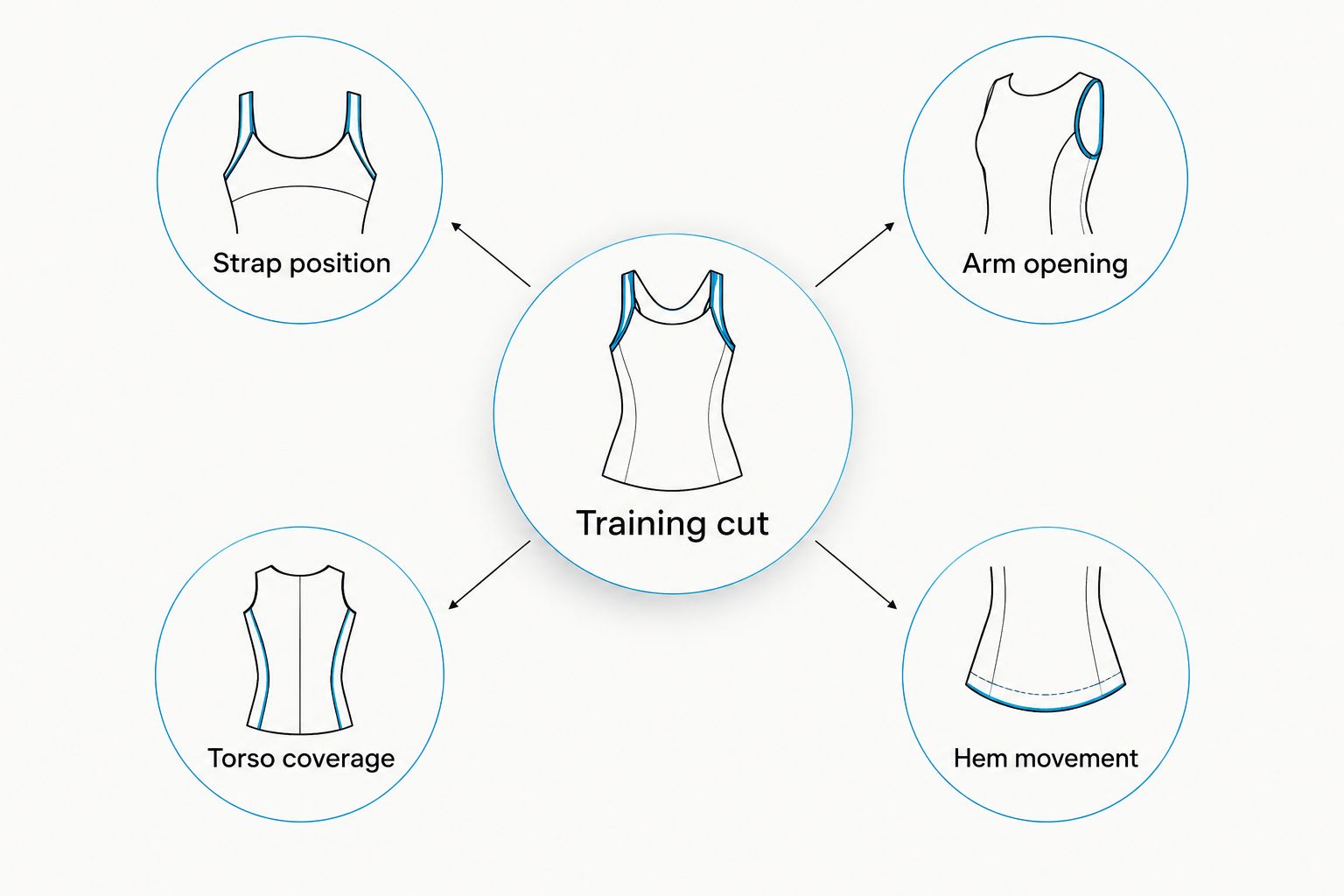
Use 3 movement checks when assessing a sample: an overhead reach, a forward reach, and a squat. Watch for straps shifting, fabric pulling, and the hem moving beyond the coverage your customer expects. These are recommended buying checks, not a laboratory performance test.
Compare a stringer with a Classic Muscle Shirt if your shoppers ask for different sleeveless styles. Inspect the actual samples rather than assuming the names establish neckline depth, armhole dimensions, or identical sizing.
For your first assessment, use 2 sample units per shortlisted style: one for repeated fit checks and one retained as a reference. Follow the care instructions on the garment used for washing checks. This is a suggested purchasing process, not a supplier requirement.
Turn the shortlist into a buying decision
Before opening an account or submitting an order, prepare 1 written reorder checklist. Record the exact garment identifier, approved sample, size labels, material description, color designation, and supplier contact route. Your next order should refer to a documented item, not a remembered appearance.
Then resolve these questions with each shortlisted supplier:
- Does the wholesale offering cover the styles you selected?
- What business documentation does the account require?
- What order and size-assortment rules apply?
- Which garment details can the supplier confirm in writing?
- How are incorrect or damaged items handled?
- What information is needed to repeat the approved order?
Keep your 2026 buying file attached to the sample approval. A garment change requires another review; the same broad category name is not enough to establish that two orders match.
Browse gym tops for your shortlist
Review stringer tanks and muscle shirts before assessing samples and confirming wholesale terms.
How the suppliers are ranked
The order follows customer fit, training cut, branding model, manufacturing information, written wholesale terms, and repeat-order clarity. The first option matches the bodybuilding customer most directly; the remaining options serve blank apparel, private labeling, and independent-brand discovery.
This is a use-case ranking, not a claim that every garment from one supplier outperforms every garment from another. Final selection belongs at the style level, supported by an approved sample and written purchasing terms.
Which wholesale fitness apparel supplier should you choose?
Choose Physique Bodyware for a bodybuilding-led retail assortment. Choose SanMar when the requirement is blank apparel for decoration, Apliiq when your own label is the priority, and Faire when you need to discover independent brands.
If you are undecided, write down the garment your customer most often asks for. A request for a stringer tank points toward a specialist gym-apparel assortment; a request for your gym logo on a shirt points toward blanks and decoration. That distinction resolves the buying route before you compare individual styles.
FAQ
What's the best wholesale fitness apparel supplier for bodybuilding retailers?
Physique Bodyware is the best fit on this shortlist for bodybuilding-focused retailers. Its stated range includes American-made stringer tanks and other gym apparel, with wholesale options for retailers. Approve samples and confirm purchasing terms before ordering.
Is SanMar better than a bodybuilding apparel brand?
SanMar is a better match when your requirement is blank apparel for decoration. A bodybuilding apparel brand is a different buying route for retailers seeking finished branded gym clothing. Choose according to the garment and branding model you need.
Where should I look if I want my own gym clothing label?
Apliiq is the private-label and customization option in this shortlist. Define the garment, intended workout, fit, and branding before evaluating its services. Custom labeling alone does not establish a bodybuilding-specific cut.
Is Faire a wholesale fitness apparel manufacturer?
Faire is a wholesale marketplace, not a single fitness-apparel manufacturer. Retailers must assess each individual brand's garments and purchasing terms. Evaluate physical samples before adding a label to your assortment.
How do I check whether a wholesale stringer tank fits well?
Check strap position, arm openings, torso coverage, and hem movement on a physical sample. Use an overhead reach, a forward reach, and a squat to inspect movement. Compare the result with the coverage and cut your customers want.
What should I ask before placing a wholesale gym apparel order?
Ask about wholesale eligibility, account documentation, order requirements, size-assortment rules, and how order discrepancies are handled. Get garment details and repeat-order information in writing. Keep that record with your approved sample.
Should I buy branded gym clothes or blank workout shirts?
Buy branded gym clothes when customers want that label and its garment styles; buy blanks when your business needs its own decoration. Private-label clothing is another route when you want a retailer-owned collection. Decide the branding model before selecting a supplier.
One last thing
Keep an approved garment as your reorder reference. Product photos help you shortlist clothing; a physical sample lets you compare the cut, fabric feel, and finish when another shipment arrives. Store the sample with its identifying details instead of relying on memory.